

For hobby perfumers · free for a limited time

The logbook for people who make perfume.

  • See the fragrance oil and base you need, in grams and ml
  • Save a formula house by house and stop hunting for the concentration
  • Keep a note on every batch so you know what to change next
  • Work out your cost and profit per bottle
18–30%
typical concentration range
ml + g
volumetric and gravimetric
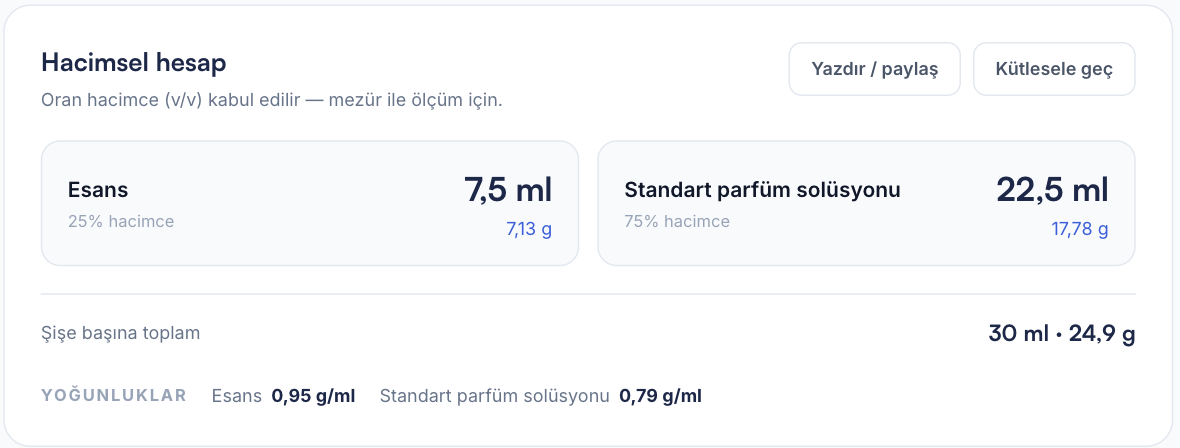
Formula summary — fragrance houses and concentrationsVolumetric calculation card — fragrance oil and base quantities
From the oil you have
4 × 50 ml bottles
How it works

A blend in three steps.

Save the concentration once and let the app do the rest. No more digging through a notebook on every batch.

1

Save your concentrations once

Enter each perfume's fragrance oil house by house — which supplier, at what concentration. You never have to open the IFRA certificate again.

Aventus · EPS 25% oil
2

Pick the bottle size

Enter the bottle you want to fill and see the oil and base quantities instantly, in both ml and grams.

50 ml bottle · 12.5 ml oil
3

Write down the batch

When the batch is done, save a score and a comment — so you know what to change on the next one.

Batch note · 4 / 10
Works both ways

Calculate from the bottle, or from the oil you have.

Start from the bottle size you want to fill, or from the fragrance oil on your shelf and see how many bottles it makes.

From the bottle

50 ml bottle, 25% oil → the fragrance oil and base you need.

Fragrance oil
12,5 ml
Base
37,5 ml

From the oil

50 ml of oil at 25% → how much blend, and how many bottles.

Blend
200 ml
Bottles
4 × 50 ml
Calculator

Try it without signing up.

Pick a bottle size, a concentration and a base; see the fragrance oil and base quantities in ml and grams. Volumetric and gravimetric side by side.

Calculation mode

Percentages are read in millilitres.

Bottle size
Concentration25%
Base
Fragrance oil
25% by volume
12.5 ml
11.88 g
Premixed base
75% by volume
37.5 ml
29.63 g
Toplam
50 ml · 41.5 g

The concentration is taken by volume (v/v): ml = volume × share ⁄ 100. Default densities: fragrance oil 0.95 · base 0.79 · alcohol 0.789 · water 1.0 g/ml.

Batch log

Every batch teaches the next one.

Save the score, the formula and your comment together; watch which concentration worked and what you changed over time.

Aventus · EPS 20%

4 / 1012 July 2026
30 mlPremixed baseSeluz2% fixative

The opening was too sharp, concentration a little high. Next one I'll drop to 18% and rest it 24 hours.

Aventus · EPS 18%

7 / 1020 July 2026
30 mlPremixed baseSeluz

Balance settled, sillage is good. Dropped the fixative and it made no difference — noted for next time.

Gucci Guilty · EPS 23%

8 / 1026 July 2026
50 mlManual base74% alcohol3% water

Came out cleaner on a manual base. Made this the main record.

Sharing and following

Share your formula, learn from someone else's batch.

Knowing where someone who tried the same oil before you settled is faster than starting from scratch. On Esansmatik you share a batch with a link, and you can follow the perfumers who send you theirs.

Your own share page

The batches you choose collect at a single address. Whoever has the link sees it without signing in, and you decide which batches appear and whether the formula is visible.

Copy a formula you like

Copy another perfumer's shared formula into your own notebook in one step. Their note stays as a read-only reference while you write your batch from scratch.

Follow and collect in a feed

Follow the perfumer whose link you have; their new batches collect in one feed. No approval, one direction — unfollow whenever you like.

Nothing you don't share is visible

Your records are private by default. There is no user search in the app: only the person you give your share link to can find you, and the share page itself is closed to search engines. Your cost and profit figures are never shared under any circumstances.

There's more

More than the blend.

Not just the concentration — cost per bottle, price history and formula sharing are all in one place.

Cost breakdown

Work out cost and profit per bottle from the oil, the base and your packaging items.

Price history

Record base and alcohol prices as they change; the cost always uses the latest one.

Print and share

Print the formula sheet, copy it as plain text, or send it with a single link.

Manual base

Set your own alcohol, distilled water and fixative shares instead of using a premixed base.

IFRA limits and safety

Every oil has a different IFRA limit — you can't hold them in your head.

The limit changes from house to house, and going over it brings irritation and allergy risk. Esansmatik stores the figure for you, but the decision and the responsibility stay with you.

No two oils work at the same concentration

IFRA limits vary from house to house and oil to oil. A single memorised number will mislead you.

Read the certificate once, then save it

Enter each oil's own limit once; after that it sits in front of you and you never search for it again.

Too high a concentration tires the skin

Going above the limit means irritation and allergy risk. Stay in the safe range.

The responsibility is yours, the maths is ours

Esansmatik works out the quantities and the cost; the final decision on which concentration is safe belongs to the maker. Verify the IFRA limits you save.

How do you read an IFRA certificate?
Blog

Writing about making perfume

Choosing a concentration, IFRA limits, essential oils and maceration — the things you learn by trying, written down.

All articles
FAQ

The most asked questions about making perfume

Short answers on concentration, materials, IFRA and longevity. The long versions are on the blog.

All questions

Free for a limited time

Every feature is open right now.

Concentration records, two-way calculation, the batch log and cost tracking — all free. We don't ask for card details; just sign up and use it.

Concentrations by houseUnlimited perfumesNo card details