How to make your own cologne at home
What “cologne” actually means, how strong to make it, and how to mix your own from fragrance oil and perfumer's alcohol. Quantities for a 50 ml bottle at three strengths.
In the US, “cologne” is mostly used to mean men's fragrance in general. On a label, though, eau de cologne is a specific strength: the lightest of the common concentration types. Before you mix anything it helps to decide which of the two you want, because the amount of fragrance oil differs by a factor of three or four.
Two meanings of “cologne”
| When people say “cologne” | What they usually mean | Typical oil share |
|---|---|---|
| On a label (eau de cologne, EDC) | A light, fresh concentration that fades within a couple of hours | 2–5% |
| In everyday US speech | Any men's fragrance, whatever the strength | Usually EDT or EDP, 5–20% |
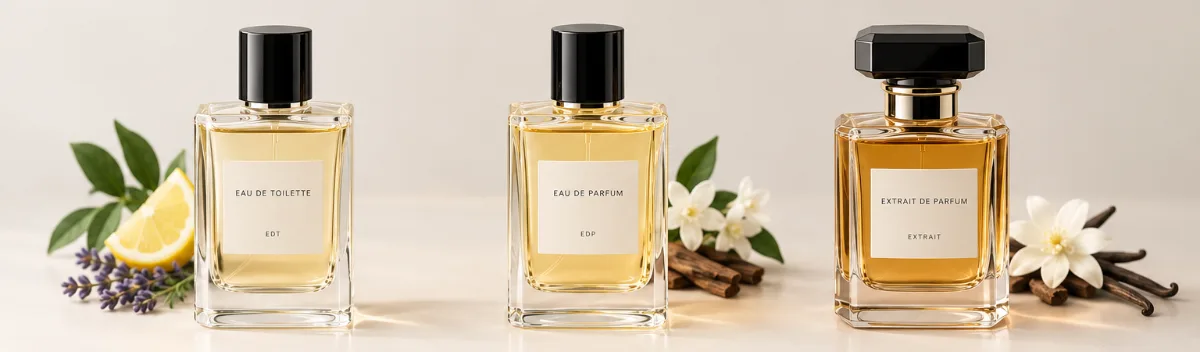
Classic eau de cologne comes from early 18th-century Cologne and is built around citrus, neroli and herbs: bright, short-lived, meant to be splashed on generously. Most men's fragrances sold today are EDT or EDP strength. If you are trying to recreate a designer scent you wear, you most likely want EDT or EDP, even though you would call it a cologne. The differences between these types are covered in EDT vs EDP vs Extrait.
What you need
- Fragrance oil: the concentrate that carries the scent. Suppliers usually sell designer-inspired oils by name and code.
- Perfumer's alcohol: denatured ethanol, sold in the US as SDA 40B. Rubbing alcohol and isopropyl have a smell of their own and aren't suitable.
- A scale readable to 0.01 g, or syringes: for small quantities a scale gives more consistent results.
- Glass bottles: a mixing bottle and a spray bottle, preferably dark glass.
Distilled water and a fixative such as DPG are optional. A small share of water can soften the opening; beyond a few percent some oils turn cloudy, and how much each oil tolerates varies. The full material list and the reasoning behind each item is in How to make perfume at home.
How much oil for a 50 ml bottle
The calculation is the same at every strength: bottle size × concentration gives the oil, the rest is base. Three common starting points:
| Strength | Concentration | Fragrance oil | Base (alcohol + extras) |
|---|---|---|---|
| Eau de cologne | 4% | 2 ml (≈ 1.9 g) | 48 ml |
| EDT strength | 12% | 6 ml (≈ 5.7 g) | 44 ml |
| EDP strength | 18% | 9 ml (≈ 8.6 g) | 41 ml |
Before settling on a number, check the oil's IFRA certificate. Cologne and perfume fall under category 4, and that row gives the maximum concentration for that particular oil. The limit differs from oil to oil, so a strength that works for one scent can be too high for another. More on reading the certificate: What is an IFRA limit.
Mixing it
- 1Weigh or measure the fragrance oil into a clean glass mixing bottle.
- 2Add the alcohol, then water or fixative if you are using them.
- 3Close the bottle and invert it gently a few times.
- 4Label it with the date, the oil's name and code, the concentration and what went into the base.
- 5Let it rest somewhere dark and cool. Many blends read more balanced after a few weeks; 2–3 weeks is a common starting point, and it varies by oil.
- 6Transfer to the spray bottle and test it on skin before deciding whether to change the concentration.
Choosing between a light cologne and a stronger one
A true eau de cologne suits fresh citrus and aromatic oils, which fade quickly at any strength; at 2–5% it is pleasant after a shower or in hot weather, and you reapply it during the day. Woody, amber and leather scents are usually made at EDT or EDP strength, because at cologne strength their base notes are hard to notice. If you aren't sure, a small test at two concentrations, 5 ml each, shows the difference with little oil used.
Whichever strength you pick, write it down with the oil and the base. Making the same bottle again a few months later is much easier when the concentration is on record, and the same oil from two different suppliers can need a different ratio. Esansmatik keeps the concentration for each oil and works out the oil and base amounts when you pick a bottle size.
If you'd rather not do the arithmetic by hand, the calculator gives you the oil and base amounts for any bottle size and concentration.
Calculate your cologne